


Activate the Football Buzz Inside Your Company — Koppa Launches Corporate Engagement Offer.
Updated: Jun 1
FBJ Editorial Team

Large-scale tournaments have a measurable impact on workplace behaviour. Surveys conducted during recent competitions indicate that a significant proportion of employees follow matches during working hours, often expecting temporary shifts in productivity and attention. Rather than treating this as a disruption, some companies are starting to treat it as a predictable dynamic that can be structured.
This is where Dutch startup Koppa, which develops white-label fantasy football platforms for companies and organisations, positions its offering.

Companies can create a fully customised World Cup environment
with integrated branding, sponsor visibility and internal communication features.
A Global Event With Local Consequences Koppa
The 2026 tournament will be the largest edition in history, expanding to 48 teams and extending the competition to more than five weeks.
The scale reflects a trajectory already visible in previous tournaments. Previous editions of the tournament attracted billions of viewers worldwide. Across broadcast, digital and social platforms, the upcoming international football tournament has evolved into one of the few moments capable of concentrating global attention at this level.
For organisations, that scale has practical implications. Attention generated externally does not remain outside the workplace. It carries into internal communication channels, informal conversations and day-to-day routines over an extended period.
“Every company experiences the tournament internally, whether they plan for it or not. The difference is whether that attention is left unmanaged or given some structure” - says Koppa’s founder Dirk Menkveld.

Structuring What Already Exists
Koppa’s model is built around a simple premise: the engagement already exists — it just lacks structure.
The company provides a fully customisable, white-label fantasy football experience that organisations can brand as their own. Employees can participate in prediction games, follow standings and engage in team-based competition, all within an environment that reflects the company’s identity.
The entry point is deliberately accessible. The platform scales from small teams to large, multi-country organisations, starting from €99 for limited user groups and expanding into enterprise deployments.
What matters in this context is not the game itself, but the consistency it introduces. Matches create a natural cadence. Leaderboards and predictions add continuity. Participation becomes part of the daily flow rather than a one-off initiative.
“The conversation is already happening,” Menkveld explains. “We’re simply giving companies a way to organise it.”
The approach has already found traction across a broad range of organisations. Koppa reports usage among more than 1,000 companies worldwide, including American Express, AB InBev and PwC — suggesting that the model resonates across both corporate scale and industry segments.
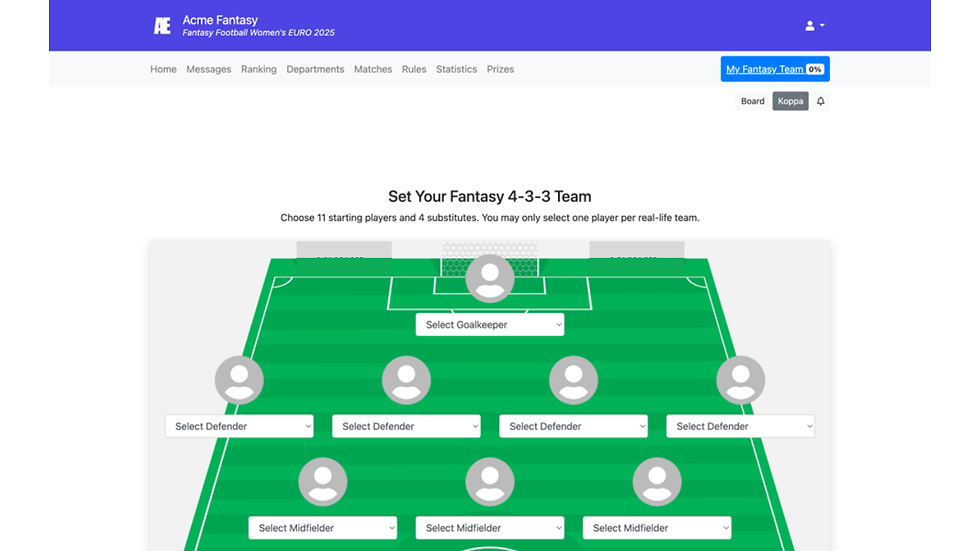
Fantasy team mechanics allow employees to build squads, compete
with colleagues and interact around the tournament on a daily basis.
A Six-Week Engagement Window
The format of the 2026 tournament provides a rare advantage. Unlike most internal initiatives, which rely on short bursts of activity, the World Cup delivers a built-in engagement cycle.
The group stage establishes a daily rhythm. Knockout rounds introduce increasing intensity. The final stages concentrate global attention.
For organisations, this translates into a sequence of recurring touchpoints over nearly six weeks — a timeframe that is difficult to replicate through traditional team-building or communication efforts.
The Data Behind the Model
The interest in gamified engagement is supported by broader workplace research.
Studies show that when game-based mechanisms are introduced:
• 90% of employees report increased productivity
• engagement levels can rise by nearly 50%
• 89% report higher job satisfaction
• 69% indicate stronger long-term loyalty to their employer
These outcomes align with wider findings from Gallup and McKinsey & Company, which link employee engagement to higher performance, retention and overall organisational effectiveness.
More granular data from Quantum Workplace shows that frequent interaction and feedback significantly increase engagement while reducing the likelihood of employee turnover.
In practice, global sporting events already activate many of these mechanisms organically. Employees follow results, exchange opinions and engage in shared moments. Structured platforms introduce consistency and visibility to that behaviour.

Live rankings and department-based leaderboards introduce
ongoing competition and recurring engagement throughout the tournament.
Beyond HR
Although often initiated by HR or internal communications teams, this type of activation extends beyond employee engagement.
Global tournaments concentrate attention across entire organisations. Internally, this creates a sustained communication channel that can be aligned with broader business objectives, including employer branding, internal campaigns and partner visibility.
Koppa’s platform allows companies to integrate branding elements, sponsor placements and communication layers directly into the experience, linking internal engagement with external positioning.
Timing as a Strategic Factor
The World Cup operates within a fixed window. Once the tournament begins, the opportunity to design structured engagement becomes significantly more limited.
“Preparation makes a clear difference,” says Menkveld. “Companies that plan early are able to build something cohesive. Those that wait tend to react to what’s already happening.”
With kickoff approaching, that planning phase is already underway for many organisations.

Employees can predict match results, follow fixtures and engage
with the tournament through a fully branded company experience.
Conclusion
The 2026 World Cup will once again dominate global attention — including within the workplace.
Employees will follow matches, engage in conversations and adjust their routines over several weeks. For organisations, the key decision is not whether this will happen, but how it will be approached.
Koppa’s World Cup 2026 offer is positioned around that reality — providing a structured, scalable way to channel attention, strengthen internal connections and extend engagement during one of the most significant global events in sport.
As Dirk Menkveld puts it:
“The upcoming international football tournament will always create energy inside a company. The question is whether that energy is used — or simply passes through.”


Comments